fall 2026chicago, ilincoming
HERE Technologies
Data Science Intern
Joining HERE Technologies this fall as a City Scholar, a UIUC program that lets students work part-time in Chicago while still carrying a full class load.
Data Science Intern
Joining HERE Technologies this fall as a City Scholar, a UIUC program that lets students work part-time in Chicago while still carrying a full class load.
Software Engineering Intern
In Progress (Summer 2026)
Undergraduate Researcher, advised by Dr. Ismini Lourentzou
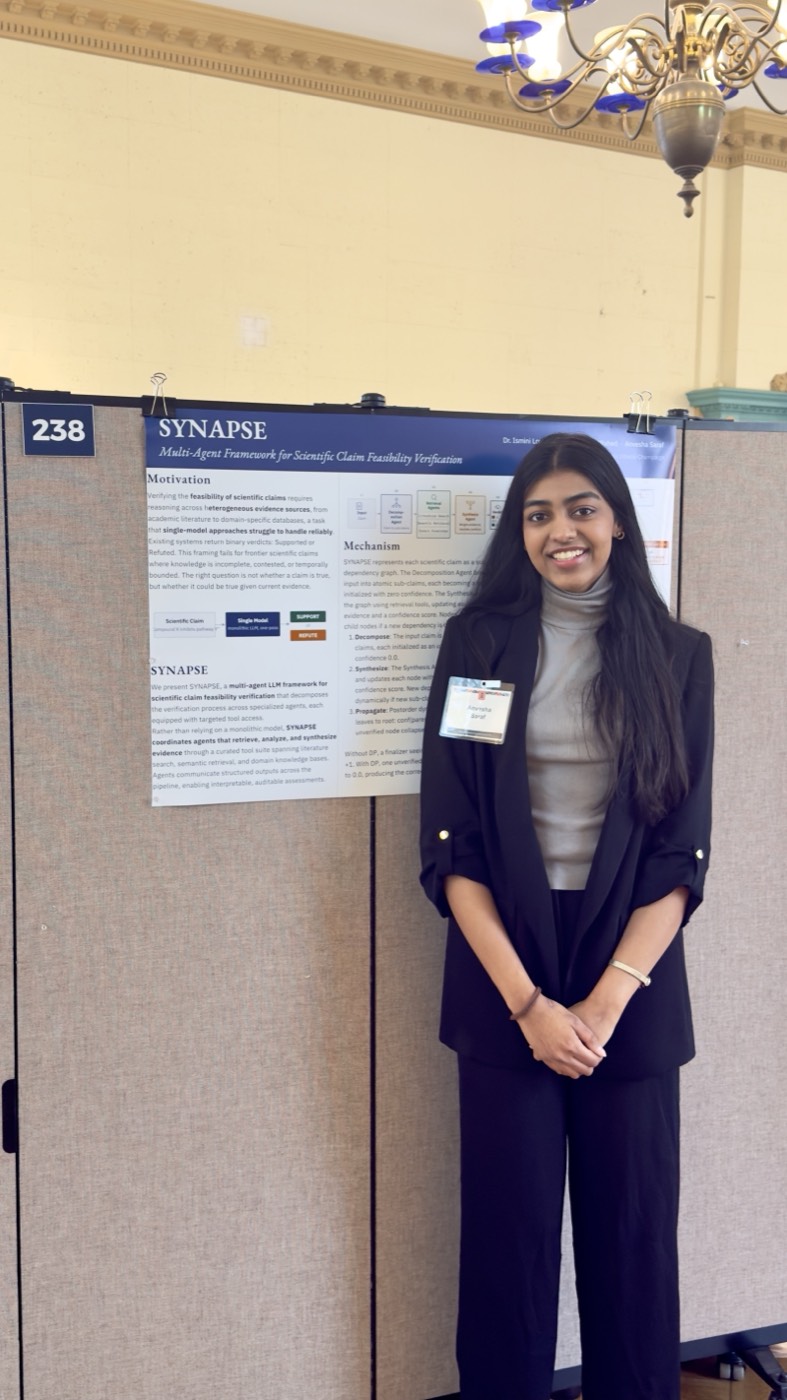
Undergraduate researcher at PLAN Lab (NCSA), advised by Dr. Ismini Lourentzou, working on multi-agent systems for scientific reasoning. Two active threads right now: SYNAPSE, on verifying scientific claims, and LatentResMAS, on how agents communicate with each other, each with its own page below.
Security & MLOps Engineering Intern (Cybersecurity)
Built a real-time MLOps pipeline for post-release attack surface monitoring on AWS SageMaker, ingesting around 2M log events a day and scoring them for anomalies. Started with unsupervised models (Isolation Forest, autoencoders), since labeled attack data is rare in security, but the false positive and false negative rates were unusable with no ground truth to anchor them. Injecting known-malicious examples and moving to supervised models (Random Forest, XGBoost) helped some, but the real fix turned out to be the input, not the model: normalizing skewed log distributions and engineering domain-aware, time-windowed features (login failures in the last 30 minutes, privilege escalations per hour). Added automated retraining, dynamic thresholding, and live inference through Dataiku Scenarios, REST API deployment, and S3-based versioning.
At a ROC AUC of 0.86, the system now handles the monitoring that used to eat roughly 220 of the ~624 hours three engineers spent on biweekly manual review each year, freeing that time for the anomalies that actually need a human.
TLDR: a system that watches deployed software for behavior that looks wrong, flags it before someone can exploit it, and retrains itself as normal behavior shifts.